

Cut resistant fabric is a remarkable innovation in the field of protective materials, playing a crucial role in safeguarding individuals across various industries. As a supplier of cut resistant fabric, I am excited to share the intricate process of how this specialized fabric is made.
Raw Material Selection
The journey of creating cut resistant fabric begins with the careful selection of raw materials. Different types of fibers are used, each with its own unique properties that contribute to the fabric's cut resistance.
One of the most commonly used fibers is high - performance polyethylene (HPPE). HPPE fibers are known for their exceptional strength - to - weight ratio. They are incredibly strong, yet lightweight, making them ideal for applications where mobility is important. These fibers have a high resistance to cuts and abrasions, which is essential for cut resistant fabric.
Another popular choice is aramid fibers, such as Kevlar. Aramid fibers are heat - resistant and have excellent tensile strength. They can absorb a significant amount of energy from a cutting force, preventing the blade from penetrating the fabric.
Stainless steel fibers are also used in some cut resistant fabrics. These fibers add an extra layer of protection, as they are extremely hard and can withstand the sharp edges of blades. They are often combined with other fibers to enhance the overall cut resistance of the fabric.
Spinning and Yarn Formation
Once the raw materials are selected, the next step is to spin them into yarns. Spinning is a process that involves twisting the fibers together to form a continuous strand of yarn.
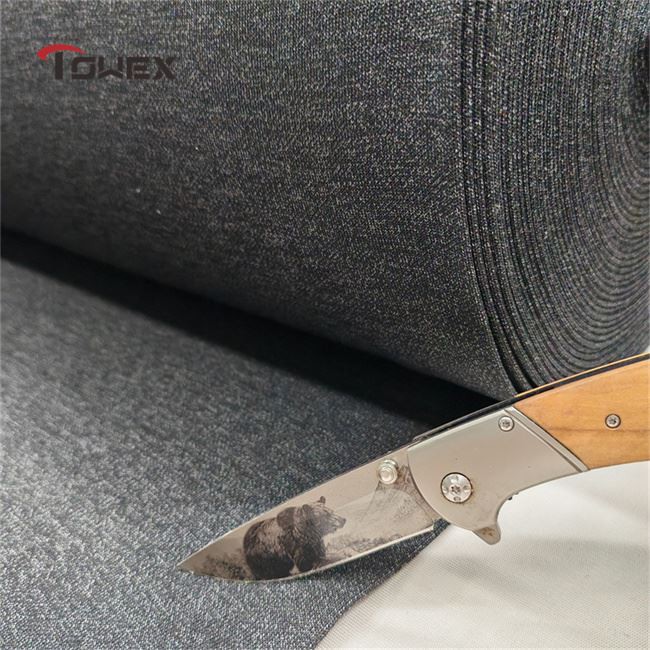
For HPPE fibers, a dry - spinning or gel - spinning process is commonly used. In the gel - spinning process, the HPPE polymer is dissolved in a solvent to form a gel. This gel is then extruded through a spinneret, and as it passes through, the solvent is removed, leaving behind a solid fiber. The fibers are then drawn to align the molecules, which increases their strength.
Aramid fibers are typically spun using a wet - spinning process. The aramid polymer is dissolved in a solvent and extruded into a coagulation bath. The solvent is removed in the bath, and the fibers solidify. These fibers are then washed and dried before being twisted into yarns.
Stainless steel fibers are usually drawn through a series of dies to reduce their diameter and increase their strength. They are then combined with other fibers, such as HPPE or aramid, to form composite yarns.
Knitting or Weaving
After the yarns are formed, they are used to create the fabric through either knitting or weaving.
Knitting is a process where the yarns are interlooped to form a fabric. There are different types of knitting techniques, such as weft knitting and warp knitting. Weft knitting is often used for creating cut resistant fabrics with high stretchability. This type of knitting allows the fabric to conform to the body's movements, providing comfort and flexibility. You can explore our High - Stretch Knitted Cut Resistant Fabric for more details on this type of fabric.
Weaving, on the other hand, involves interlacing two sets of yarns at right angles to each other. The warp yarns run lengthwise, while the weft yarns run crosswise. Weaving can produce fabrics with different patterns and structures, which can affect the fabric's cut resistance and other properties.
Coating and Finishing
Once the fabric is knitted or woven, it may undergo a coating or finishing process to enhance its performance.
A common coating used for cut resistant fabrics is a polyurethane (PU) coating. This coating can improve the fabric's water resistance, abrasion resistance, and cut resistance. It also helps to protect the fibers from environmental factors, such as moisture and chemicals.
Some fabrics may also be treated with anti - microbial agents to prevent the growth of bacteria and fungi. This is especially important in applications where the fabric is in contact with the skin, such as in gloves.
Testing and Quality Control
Before the cut resistant fabric is ready for the market, it undergoes rigorous testing to ensure its quality and performance.
One of the most important tests is the cut resistance test. There are different standards for cut resistance, such as the ANSI/ISEA 105 and EN 388 standards. These tests measure the fabric's ability to resist cuts from a blade under specific conditions.
Puncture resistance is also an important property of cut resistant fabric. The fabric is tested to determine its ability to withstand punctures from sharp objects. Our ANSI A8 and EN388 Puncture Level 4 Soft Fabric meets high standards of puncture resistance.
In addition to cut and puncture resistance, the fabric is also tested for other properties, such as abrasion resistance, tear strength, and flexibility.
Applications of Cut Resistant Fabric
Cut resistant fabric has a wide range of applications in various industries.
In the manufacturing industry, it is used to make protective gloves, aprons, and sleeves for workers who handle sharp tools or materials. These protective garments help to prevent injuries and increase worker safety.
In the food processing industry, cut resistant fabric is used to make gloves for workers who handle knives and other sharp utensils. The fabric's cut resistance ensures that workers are protected from accidental cuts.
In the law enforcement and military sectors, cut resistant fabric is used to make body armor and protective clothing. It provides an extra layer of protection against knife attacks and other sharp objects.
You can also find cut resistant fabric in fashion and sports applications. For example, some designers use cut resistant fabric to create stylish and functional clothing. In sports, it can be used to make protective gear for activities such as fencing and martial arts. Our Knife Resistant Fabric Striped Pattern offers a unique and practical option for these applications.
Conclusion
The process of making cut resistant fabric is a complex and highly technical one. From the selection of raw materials to the final testing and quality control, every step is crucial in ensuring the fabric's performance and reliability.
As a supplier of cut resistant fabric, we are committed to providing high - quality products that meet the diverse needs of our customers. Whether you are in the manufacturing, food processing, law enforcement, or fashion industry, our cut resistant fabric can offer the protection you need.
If you are interested in purchasing cut resistant fabric for your business or project, we invite you to contact us for a detailed discussion. We can provide you with samples, technical specifications, and pricing information to help you make an informed decision.
References
- ASTM International. (2023). Standards for cut resistant materials.
- European Committee for Standardization. (2023). EN 388: Protective gloves against mechanical risks.
- ANSI/ISEA. (2023). ANSI/ISEA 105: Standard for hand protection - Performance requirements and test methods for cut resistant gloves.